Can't choose between two names? A tie-breaker framework
By Domain Yoga · Last updated July 22, 2026
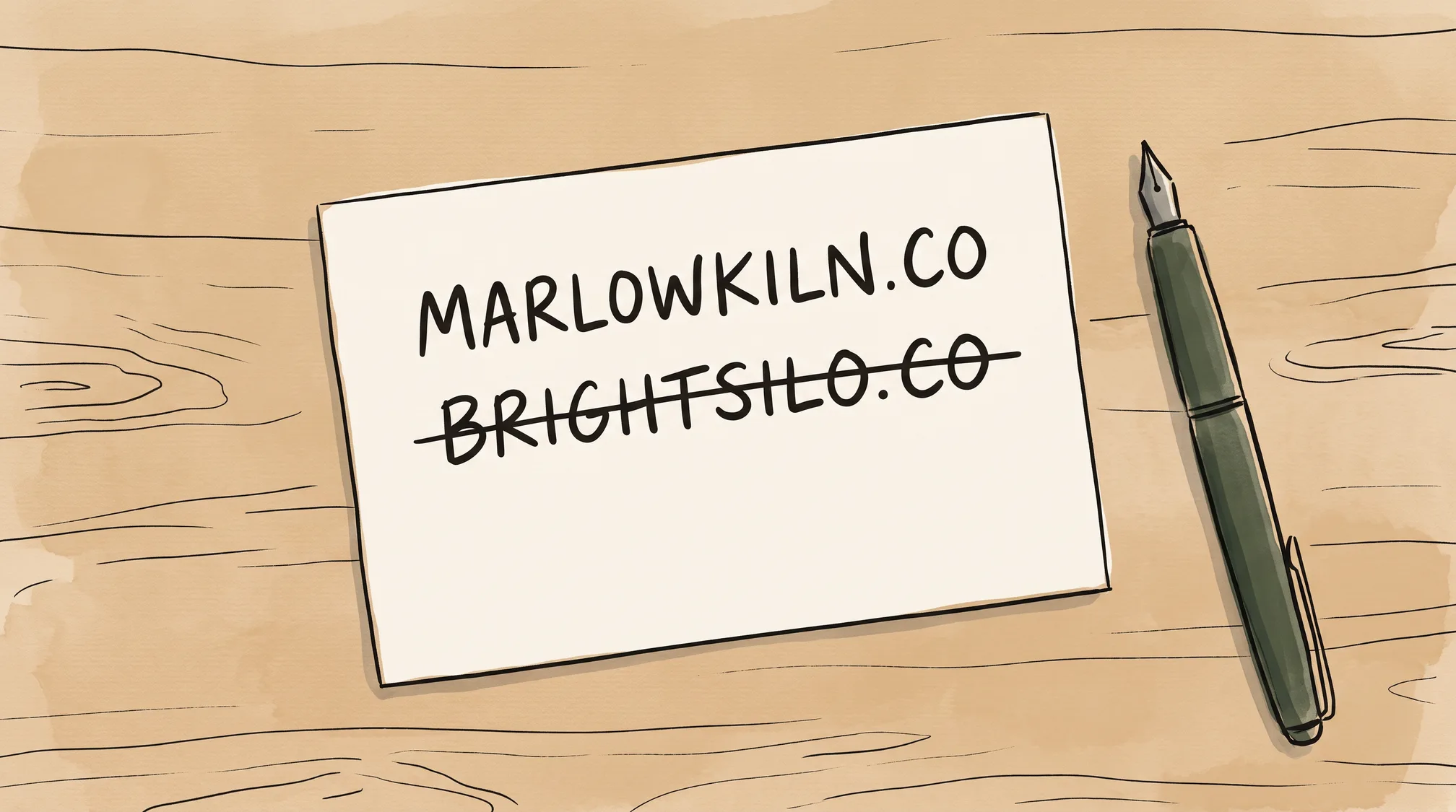
Here’s the reframe you need before any framework: if you’ve narrowed the field to two names — the point where a 1-hour naming sprint hands off — and you genuinely like both, they are almost certainly both good enough. Truly bad names don’t make it to a final of two. Past that bar, the difference between your finalists is smaller than the cost of not deciding: every week you deliberate is a week without a landing page, a repo name, or a single customer hearing either name out loud. The correct move is to decide fast and start building meaning into the winner. But “just flip a coin” is unsatisfying, and there is a real difference between deciding arbitrarily and deciding quickly with evidence. So here’s the method: one evening to score both, a couple of days to test both, one round of tie-breakers, and a decision by the end of the week.
Step 1 — Score both names on what actually matters
Build a small weighted scorecard and fill it in for both finalists. Not a pros-and-cons list — those reward whichever name you thought about last. Rate each name from 1 to 5 on the criteria that actually predict a strong brand:
- Say-ability: can someone say it comfortably in a sentence, and does it survive the radio test — heard once, found later?
- Spell-after-hearing: would a stranger type it correctly into a browser with no help?
- Distinctiveness: does it stand apart from competitors and dictionary noise, or does it blur into the category?
- Length: shorter names are easier to say, type, and remember; every extra syllable is friction.
- Availability: is a clean domain free on the TLDs you’d actually accept — the ones you’d be proud to put on a slide?
- Trademark clearance: does a basic search come back quiet in your industry and region?
Then weight them. If your product spreads by word of mouth, double the weight on say-ability and spell-after-hearing. If you’re in a crowded category, double distinctiveness. The traits themselves are covered in depth in what makes a name brandable, and if you want the same lens applied automatically, our methodology scores names on exactly these dimensions — length, radio test, phonetics, distinctiveness, TLD fit. A scorecard won’t make the decision for you, but it often reveals that the “tie” is actually a two-point gap you’d been feeling but not admitting.
Step 2 — Break the tie with evidence, not opinion
By this point you can’t hear either name the way a stranger will. You’ve seen both names hundreds of times; you know how they’re spelled, what they mean, and which one you secretly drafted first. Fresh strangers have none of that context, which is exactly why they’re useful.
The move here isn’t new tests; it’s running the same small tests on both names and comparing the numbers. The recall test, the spell-back test, the “I work at ___” test — all of them are laid out in how to test a name before committing, and this is the moment to use them head-to-head. Same script, same kind of people, one name per person so nobody’s comparing. Then count: how many spelled each name right, how many remembered it a day later, which one felt natural to say in a sentence. When one name goes four-for-five on spell-back and the other goes two-for-five, the tie is broken and your opinion didn’t have to do it.
Step 3 — Apply the real tie-breakers
If the scorecard and the tests are still close, ask five decidable questions. Not “which do I love more” — questions with actual answers:
- Which has the cleaner domain available? The .com, or an exact match on the TLD you actually want — no hyphens, no “get” prefix, no compromise.
- Which does a stranger say correctly on the first try? You already have this data from Step 2. First-try wins compound forever.
- Which are you less likely to be bored of in three years? Clever names age fastest; the pun that delights you today is the one you’ll wince at in year two.
- Which survives a pivot? If the product shifts sideways, does the name come along, or is it welded to a feature you might kill?
- Which is harder to copy? A distinctive, ownable name forces competitors to sound like imitators. A generic one invites lookalikes.
Any single “clearly this one” on this list is permission to stop. You don’t need a sweep — you need one honest asymmetry.
Why you shouldn’t put it to a vote
Gather input widely, but let exactly one person decide. Polling your team, your group chat, and your followers feels rigorous, but consensus has a known failure mode: it averages toward the least objectionable option, not the best one. Distinctive names tend to polarise — that’s part of what distinctive means — so a vote systematically punishes the bolder finalist. Collect the spell-back data, hear the objections, then have one decider (probably you) make the call and own it. The full naming process in how to name a startup is built around the same principle: input is a group activity, deciding is not.
When do you stop?
Set a deadline, decide, and start pouring meaning into the name. Give the whole framework one week, then call it. Names feel enormous before launch because they’re the only thing that exists yet. A distinctive, sayable name still compounds — which is why running the scorecard was worth it — but past the good-enough bar, the product makes the name far more than the name makes the product. “Stripe” and “Notion” score well on that scorecard, yet even they were just clean, unremarkable words until the products taught us what they meant.
And if it’s genuinely still a tie after the scorecard, the tests, and the tie-breakers? Take the one with the cleaner, more ownable domain and go. Both names were good enough three steps ago; the only losing move is shipping neither. The name’s real test isn’t your deliberation — it’s whether the thing behind it works, which is why validating with a landing page first beats another week of agonising every time.
Still circling because neither finalist has the domain you want? Domain Yoga generates available, brandable names scored on the brandability criteria in Step 1 — sometimes the fastest way to break a tie is a third option that beats them both.