.com vs .io vs .ai vs .co: which should you pick in 2026?
By Domain Yoga · Last updated July 27, 2026
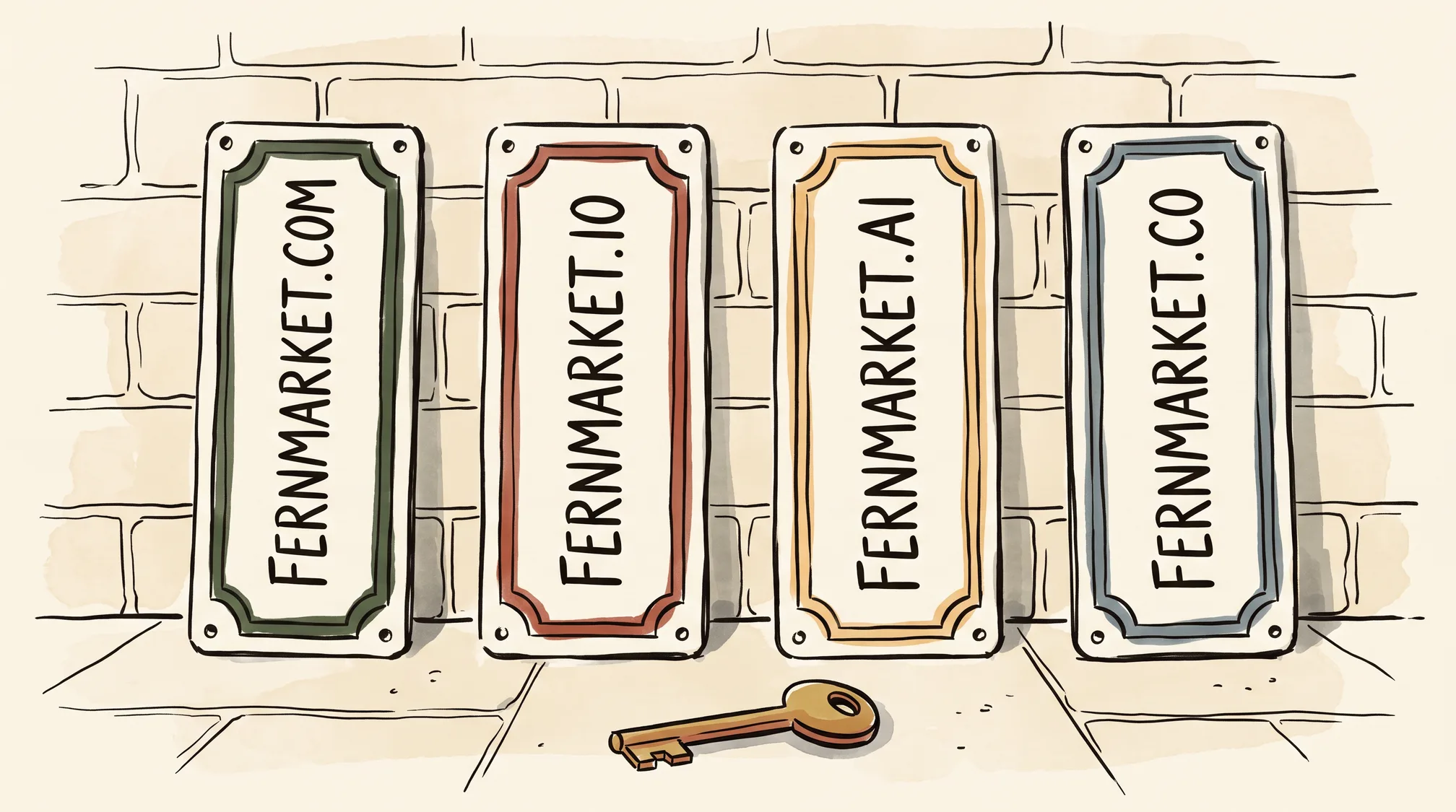
Pick by audience, not by SEO — because on the SEO front there is nothing to pick. Google has said consistently for over a decade that the TLD is not a ranking signal: a .com, .io, .ai, and .co with identical content rank identically. That collapses the decision into three things you can actually reason about — who your audience is, what each extension connotes, and what it costs. The short version: .com for mainstream and consumer audiences, .io for developer tools, .ai when artificial intelligence is the product, and .co as the credible fallback when the .com you want is taken.
Does Google care which one you choose?
No, and it’s worth being blunt about it, because “buy the .com for SEO” and “.ai domains rank better for AI queries” both still circulate. Google’s official position since 2015 is that all gTLDs are treated alike, and its documentation treats .io, .ai, and .co — technically country-code domains — as generic ccTLDs as of 2026, meaning they get no automatic geotargeting to their home territories either. Your .ai domain doesn’t quietly target Anguilla, and it doesn’t get an algorithmic boost for AI-related searches. If you want the full myth-busting treatment, see do exotic TLDs hurt SEO?
Since the ranking playing field is level, everything below is about humans: what your prospective users assume when they see the address.
What does each extension actually signal?
- .com is the mainstream default. It’s the extension every audience on earth recognizes, the one browsers and brains autocomplete, and the safest choice when your buyers are consumers or non-technical businesses. Its downside is pure scarcity: most good short .coms are taken or expensive. If your audience skews mainstream, it’s worth checking whether you’re in a case where you genuinely need the .com before settling for an alternative.
- .io reads as developer-native. Open to anyone worldwide with no restrictions, and long-established as the address of dev tools, APIs, and infrastructure products — to a technical audience it signals “built by people like you.” One honest asterisk: .io is tied to the British Indian Ocean Territory, and the UK–Mauritius treaty over the Chagos Archipelago’s sovereignty remains unratified and stalled as of July 2026 — the UK’s implementing bill died at prorogation in April 2026 — with no TLD-level decision made or announced by anyone. Day-to-day registration and use are unaffected, and any transition — if one ever happens — would likely unfold over 5–10 years under IANA’s own retirement rules, not overnight. We cover the situation properly in our guide to country-code domain hacks.
- .ai says the product is artificial intelligence. Anguilla’s extension has become the de facto home of AI startups, and if AI is your category, it does positioning work no other TLD can. It’s also the priciest of the four: expect roughly $80–160 per year depending on registrar and promos as of 2026, with a mandatory 2-year minimum term — so budget the full two-year total up front, not a first-year teaser rate. Whether that premium earns its keep for your project is a question of its own: is a .ai domain worth it?
- .co is the startup shorthand for “company.” Colombia’s extension, open to global registration since July 2010 and deliberately marketed as an alternative when the matching .com is taken. It’s short, cheap relative to .ai, and reads naturally to a general audience. Its one structural weakness is that it’s a single keystroke from .com — if someone else holds yourname.com, expect a slice of typed-in traffic and misaddressed email to leak their way.
A note on respectability, since founders worry about it: .io, .co, and .ai are all widely perceived in the tech world as legitimate, mainstream choices used by real, funded startups. That’s perception and convention rather than a guarantee — trust ultimately comes from what’s on the site, not the suffix — but none of these four will make you look unserious.
How do you actually decide?
Match the extension to the people typing it, in this order:
- Non-technical or consumer audience → .com. Recognition beats cleverness when your users don’t live in tech. If the .com is unavailable, .co is the closest substitute in feel.
- Developers and technical buyers → .io. The connotation does marketing for you, and this audience won’t blink at it. Weigh the sovereignty uncertainty as a minor long-horizon factor, not a reason to avoid it today.
- AI-first product → .ai. The category signal justifies the price if AI is genuinely the pitch — and looks like trend-chasing if it isn’t.
- Great name, taken .com, broad audience → .co. The pragmatic pick that keeps the exact name you want without a technical connotation you don’t.
Price and commitment are the tie-breakers: .com and .co renew cheaply, .io sits in the middle, and .ai demands the largest and longest commitment of the four.
The real work isn’t choosing the suffix — it’s finding a name strong enough that the suffix barely matters. Domain Yoga takes a plain-language description of what you’re building and returns around 250 availability-checked, brandability-ranked name ideas across .com, .io, .ai, .co, and many other extensions, so you can compare your options across all four side by side before you commit.
The startup name generator shows how this plays out in practice: in one search for a software tool, not a single surviving name was a .com.