Accents, umlauts & IDNs: can you use them in a domain?
By Domain Yoga · Last updated July 27, 2026
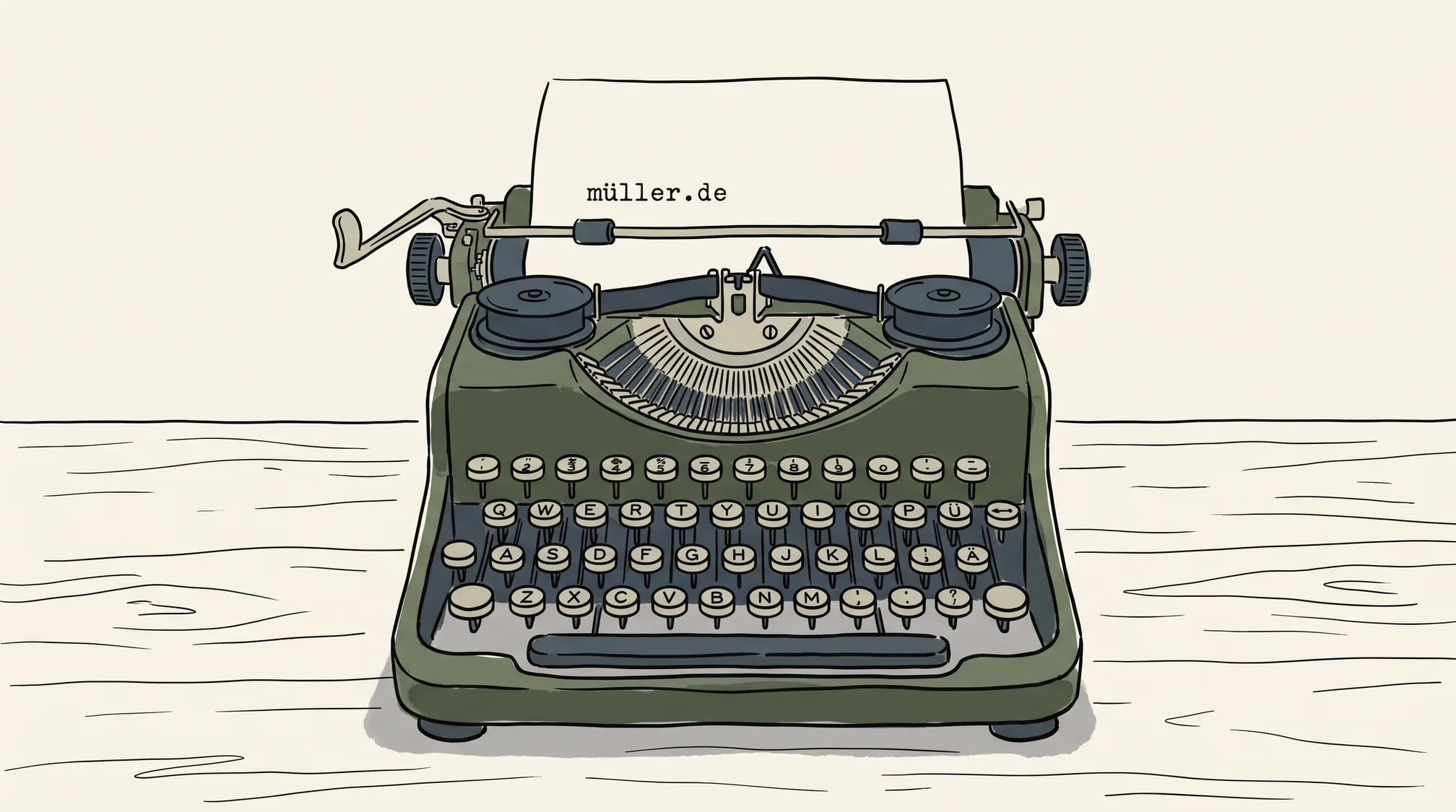
Yes — you can put accents and umlauts in a domain name, and under most European TLDs you’ve been able to for well over a decade. German .de domains can contain ä, ö, ü, and even ß; French .fr has allowed diacritics since 2012; .eu has supported them since 2009. Browsers, too, now mostly display these domains as the readable Unicode you registered, not as machine gibberish. So the interesting question isn’t “can I register müller.de?” — it’s “can I run a business on it?” Registration is the easy part. The friction lives downstream, in the everyday tools a company depends on — and above all in email. As with hyphens and numbers, the honest answer is “yes, but” — and the but is not where most people expect it.
How does a ü end up in DNS at all?
It doesn’t, quite. DNS only speaks ASCII, so internationalized domain names (IDNs) work by translation: the Unicode name you see is converted by the Punycode algorithm into an ASCII string with the telltale xn-- prefix, under a standard called IDNA2008. The Swiss registry’s own example: bücher.ch is stored in DNS as xn--bcher-kva.ch. Same domain, two representations — one for humans, one for the infrastructure.
One practical footnote: the 63-character limit on a domain label applies to the encoded xn-- form, which is always longer than what you typed. A short-looking accented name eats into that limit faster than its ASCII twin ever would.
Which TLDs actually allow accents and umlauts?
Most European ccTLDs — plus .com, .net, .org and .eu — with a few sharp exceptions worth knowing before you fall in love with a name.
| TLD | Accents allowed? | The fine print |
|---|---|---|
| .de | Yes | ä, ö, ü, ß among 93 extra characters; ß registrable in its own right since Nov 2010 — straße.de and strasse.de are separate domains |
| .at | Yes | ä, ö, ü and more; contractually you register the Unicode name itself, not the xn-- string |
| .ch / .li | Yes | bücher.ch lives in DNS as xn—bcher-kva.ch |
| .fr | Yes | Broad Latin diacritics (incl. ç, œ, ü, ß) since May 2012 |
| .eu | Yes | Latin, Greek, and Cyrillic — script must match the TLD variant (.eu / .ευ / .ею); no mixing |
| .es | Yes | Including ñ — españa.es is stored as xn—espaa-rta.es |
| .pl | Yes | Latin diacritics plus separate Greek, Cyrillic, and Hebrew sets; no mixing between sets |
| .se / .no / .dk | Yes | Each registry’s own national-character set (Nordic vowels; .no also covers Sámi letters) — check the registry’s table before committing to a spelling |
| .org | Yes | Second-level IDNs for German, Swedish, Danish, Polish and other languages since 2005 |
| .com / .net | Yes* | 100+ scripts supported — but ß is explicitly prohibited, as is Greek final sigma |
| .nl | No | ASCII only — letters, digits, hyphens. No accents of any kind |
| .app / .dev | No | Google’s registries don’t support IDN at all |
Not listed here? IANA publishes the registry IDN tables, which is the authoritative place to check a TLD this table doesn’t cover.
Two rows deserve emphasis. First, .nl supports no IDN whatsoever — the Dutch registry’s requirements allow only letters, digits, and hyphens, making the Netherlands the standout gap in an otherwise accent-friendly Europe. Second, Verisign bans ß on .com and .net for backward-compatibility reasons, even though .de and .fr both permit it. A German brand built on ß can own straße.de but can never hold the matching .com — only the ss-spelled form. If the .com matters to your plans, that single character just made the decision for you. And don’t assume new TLDs are the modern, permissive option: IDN support is decided registry by registry, and Google’s .app and .dev allow none. The full landscape of European country-code domains is worth a look before you commit to one.
Will browsers show müller.de or xn—mller-kva.de?
Mostly the readable form. Chrome displays IDNs as Unicode by default and only forces the raw xn-- punycode in specific cases: when a label mixes scripts that don’t belong together, when the name fails conversion, or when a stripped-down “skeleton” of the domain matches a well-known site — the defense against lookalike attacks such as a fake paypal.com built with a Cyrillic “а”. A legitimate, single-script German or Nordic brand name trips none of those wires, so it renders as the name you registered. Firefox behaves similarly in practice for European registries with strict anti-spoofing policies, while Safari is generally the strictest of the three about falling back to punycode — worth a quick check on Apple devices if your market skews that way. HTTPS, at least, is a solved problem: Let’s Encrypt has issued certificates for IDNs since 2016, against the punycode form.
Can you actually run email on an accented domain?
Here is the trap the whole question funnels into. The standards exist — email address internationalization was specified back in 2012, and modern mail servers implement it — but hosted providers are where founders actually live, and their support is uneven:
- Gmail has supported internationalized domains since 2014 — the long-standing good citizen here.
- Microsoft 365 switched on internationalized-email support in 2018, but that rollout explicitly did not allow assigning IDN addresses to actual mailboxes — only uses like mail-flow rules. Whether that mailbox limitation has since been fully lifted is something we could not confirm from Microsoft’s current documentation, so treat it as an open question and test with a real tenant before you commit.
- Fastmail’s own documentation requires the domain entered in punycode form —
xn--mller-kva.de, notmüller.de— and Proton Mail users report the same workaround in its community threads. Worth being precise about what that costs: it’s a one-time entry in a settings screen. The address your customers see is stillhello@müller.de. The friction is the administrator’s, not the brand’s.
So the answer depends on your mail provider more than on your country. On Google Workspace, an IDN-primary setup is genuinely viable. On Proton or Fastmail, budget for a punycode step at setup. On Microsoft 365, test with a real tenant first — that 2018 mailbox limitation has never been clearly retracted. Our guide to setting up email on your domain covers the mechanics; whatever provider you choose, verify IDN support before printing business cards.
What else quietly refuses the umlaut?
This is the part that actually carries the verdict. Registrars first: Cloudflare Registrar doesn’t sell IDN domains at all, though it will happily manage DNS for one registered elsewhere. Mainstream registrars like GoDaddy, Namecheap, and IONOS handle them fine. Beyond registration, a documented 2021 write-up of running a Thai-script IDN found Route 53 rejecting the Unicode form, Instagram and Twitter refusing the link outright, and LinkedIn silently converting it to ASCII. That’s one case in a different script rather than a universal rule — but the shape of the problem generalizes, and it’s the one nobody has fixed: every third-party form field is another chance for your name not to survive the trip.
There’s a human layer too, and it isn’t where you’d guess. The friction isn’t at home — a German says “u-Umlaut” and is understood instantly, a Spaniard says “eñe.” It’s the call to the supplier in Rotterdam and the sign-up form in Dublin where the character stops travelling, the kind of thing testing a name out loud surfaces in minutes.
So should you use the accented name or not?
Use both — with clear roles. For many European brands the accented form is the real name: Müller is not “Muller,” it’s a different spelling of a different word, and in its home market that’s simply an error. So register the IDN, use it in print and local marketing where the correct spelling carries credibility, and redirect it to your primary domain. But run the cross-border machinery — sign-up links, third-party integrations, anything typed into someone else’s form — on the ASCII transliteration.
Choose that transliteration deliberately, because it’s a real concession rather than a free win, and the two options aren’t equivalent: dropping the diacritic can change the word outright (schön becomes schon, año becomes ano), while the German-style ue/oe/ae spelling at least preserves the sound. It’s the same defensive logic as registering multiple domains. If you’re naming across borders anyway, the multilingual EU naming traps deserve the same early attention.
And if the hunt for a workable ASCII form sends you back to the drawing board, Domain Yoga generates around 250 availability-checked ideas per search, ranked on brandability signals including spellability — see our methodology — at $2–$5 a search, no subscription, credits never expire.
The mapping from what you type to what is registered is specified rather than improvised: Unicode UTS #46 defines the processing, and RFC 5890 the underlying IDNA framework. Both explain why two names that look identical can be different domains.