The renewal trap: first-year vs renewal domain pricing
By Domain Yoga · Last updated August 16, 2026
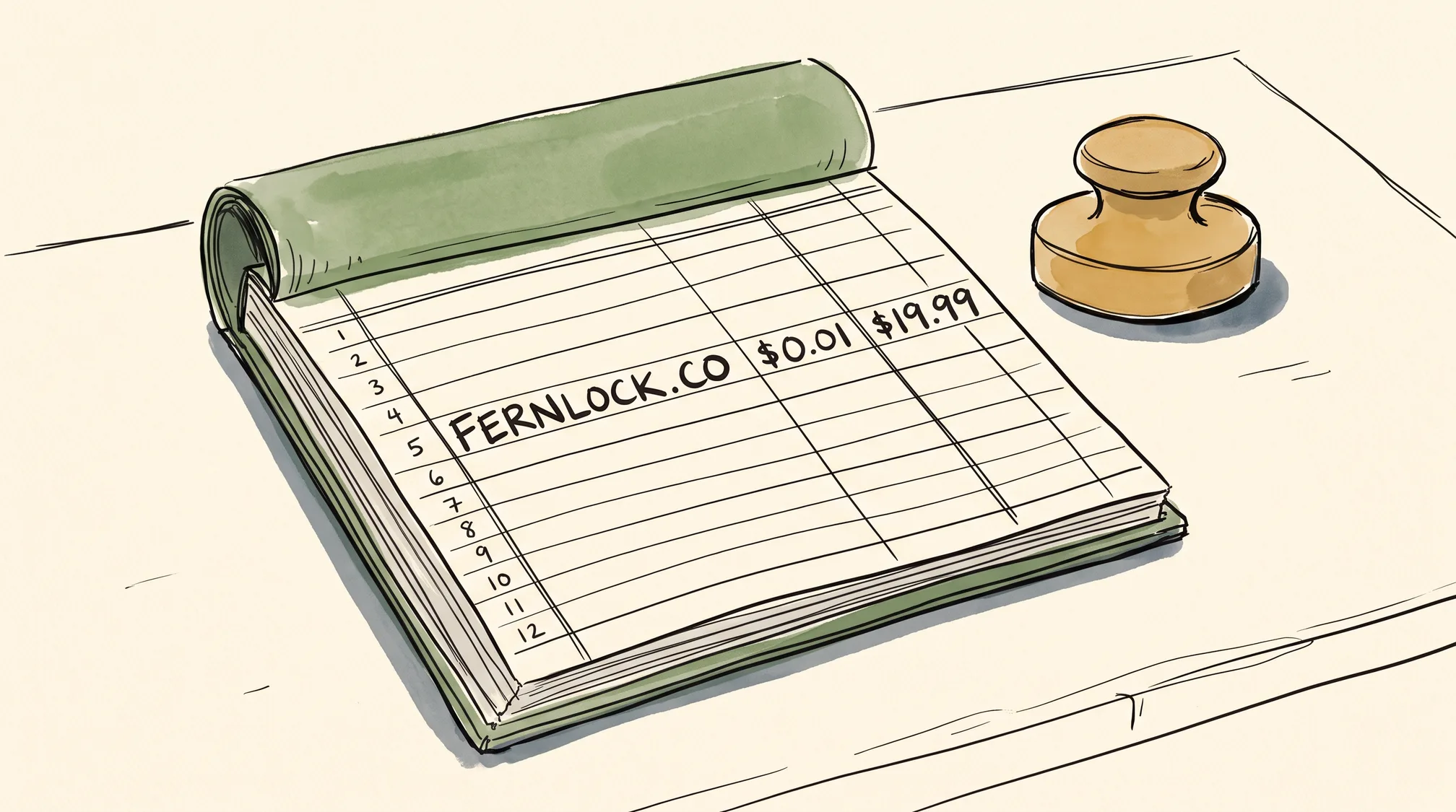
You can register a .com for one cent. Hostinger’s public pricing page offered exactly that when we checked on July 27, 2026 — and the same page states, in plain text, “After that, the renewal fee is $19.99/year.” That’s a roughly 2,000x jump, and it answers this article’s title in one row: the first-year price is not the price of the domain. It’s a customer-acquisition offer. The renewal is the price, and the gap between the two can be enormous. We flagged this trap in passing in the cheapest TLDs that don’t look cheap; this piece puts same-day, primary-source numbers on it — and the numbers show the gap depends at least as much on the registrar as on the TLD.
How much do domain renewals go up after the first year?
Every figure below comes from the registrar’s own public pricing pages, all checked on July 27, 2026. Prices are USD unless marked; multiples are rounded.
| TLD | Registrar | First year | Renewal | Multiple |
|---|---|---|---|---|
| .com | Hostinger | $0.01 | $19.99 | ~2,000x |
| .com | IONOS | $10 | $20 | 2x |
| .com | Dynadot | $10.88 (with listed coupon) | $10.88 | 1x |
| .com | Porkbun | $11.08 | $11.08 | 1x |
| .xyz | Dynadot | $1.99 | $13.17 | ~6.6x |
| .xyz | IONOS | $12 | $15 | ~1.3x |
| .shop | Dynadot | $1.00 | $32.32 | ~32x |
| .shop | IONOS | $0.98 | $56 | ~57x |
| .store | Dynadot | $2.50 | $43.02 | ~17x |
| .store | IONOS | $1.47 | $84 | ~57x |
| .tech | IONOS | $3 | $105 | 35x |
| .website | IONOS | $1 | $40 | 40x |
| .dev | Dynadot | $8.00 | $12.50 | ~1.6x |
| .app | Dynadot | $8.00 | $14.50 | ~1.8x |
| .ai | Dynadot | $85.60 | $85.60 | 1x |
One caveat about that table before you read anything into it: IONOS dominates its high end partly because IONOS publishes a complete public price list. Registrars that don’t disclose renewals can’t appear here at all — read absence as missing data, not innocence. And the multiple is dramatic when year one costs a cent; the renewal price itself is the number to budget against.
The worst gaps cluster in the loss-leader corner of the new gTLD landscape: a $0.98 .shop that renews at $56, a $1.47 .store that renews at $84, a $1 .website that renews at $40. The mainstream extensions behave differently — .com is genuinely flat at Porkbun, and at Dynadot’s coupon price, and among the big four of .com, .io, .ai, and .co, .ai was flat at $85.60 (with a mandatory two-year minimum term) and Google’s .app and .dev showed modest 1.6–1.8x gaps. The surprise was .co: Dynadot quoted €3.14 for year one and €28.12 at renewal — roughly 9x, and yes, in euros; more on that below.
Does the trap come from the TLD or the registrar?
The obvious reading of the table — some TLDs are traps, some aren’t — is incomplete. Look at .xyz on the same day: a 6.6x multiple at Dynadot ($1.99 → $13.17) but only about 1.3x at IONOS ($12 → $15). Or .store, renewing at $43.02 at one registrar and $84 at the other — same TLD, same day, nearly double the price. The renewal multiple is a property of the registrar’s pricing strategy at least as much as the TLD’s economics, which means registrar choice is your biggest lever — our registrar guide for indie hackers compares the flat-pricing options in depth. A “worst TLDs” list would be tidier, but it would also be wrong at half the registrars you might use.
Why do renewals cost more than the first year?
Two forces, working in opposite directions. The floor under every .com is Verisign’s wholesale price: currently $10.26 per year, rising 7% to $10.97 on November 1, 2026. Section 7.3(d) of the .com registry agreement sets that maximum price and lets Verisign raise it 7% in each of the final four Pricing Years of every six-year period, with the term running to November 30, 2030. On top of that sits ICANN’s per-domain transaction fee, which rose from $0.18 to $0.20 per domain-year on July 1, 2025. Together that puts the no-margin cost of a .com at about $10.46 today, rising on a schedule no registrar controls — even a registrar with zero appetite for teaser games has to move renewals when the wholesale price moves.
The teaser side of the gap appears to be the registrar’s own spend. At the one registry that publishes its wholesale price openly, we found no evidence of a subsidy: the .xyz registry’s own pricing page lists a flat default of $15 per year to create, renew, and transfer, with no promotional tier in sight. A $1.99 first-year .xyz looks like a registrar absorbing a loss to acquire you — the intro-price economics of any subscription business. The renewal isn’t a penalty; it’s the return to list price.
Is a big first-year discount dishonest?
No — and this article shouldn’t be read as an accusation. Promotional first-year pricing is legal, disclosed by most registrars at the point of sale, and often a genuinely good deal for year one. The distinction worth drawing is between a gap you can see and a price you can’t.
Hostinger’s ~2,000x multiple is enormous, but the $19.99 renewal is printed on the same public page as the one-cent offer. IONOS publishes its entire first-year and renewal price list openly, no login required — its .com doubles from $10 to $20, and it deserves credit for showing you that before you buy. Porkbun goes further: $11.08 for a .com, with its own copy promising “the price you see is the price you pay, year after year.” Cloudflare Registrar sells at wholesale cost by explicit policy — no markup, and it states it “will never add surcharge fees for your renewal.”
Two registrars returned 403 to our automated checks, and it’s worth being precise about what that does and doesn’t mean. Namecheap’s is not a transparency finding: it publishes register, renew, and transfer prices side by side on a public page — we simply couldn’t machine-read it, and we won’t quote a figure we didn’t capture ourselves. Bot-blocking is standard anti-scraping infrastructure, not a signal about what customers can see.
GoDaddy is the different case. Its renewal price for a domain you already own isn’t on a public price list; its own help article routes you to a “renewal price” column inside your account. You will see the renewal rate at checkout before you buy, without an account — but there’s no standing public table to compare against beforehand, which makes it harder to price against than registrars that publish one. A promo you can price against is ordinary retail; a renewal price you can only find at the last step is where “trap” starts to fit.
Can you buy a domain name permanently?
No — and it’s worth being precise about why, because permanent ownership is exactly the assumption the renewal trap preys on. A domain is not sold; it’s leased. Registering one buys you a term — for gTLDs, anywhere from one to ten years, ten being the maximum ICANN’s rules allow, while ccTLDs set their own limits. When the term ends you renew at whatever the renewal price is by then, or the domain works through the expiry lifecycle and eventually drops for anyone to register. Even buying a taken domain on the aftermarket only transfers the registration to you; the annual renewals come with it. There is no buy-once, own-forever option for a standard domain.
The closest substitute is registering for the full ten years with auto-renew on. For a name you are committed to that is genuinely worth doing, and it locks every prepaid year at today’s standard rate — standard, note, not the teaser. What it cannot do is lock the price of year eleven. A long registration fixes your term, not your future renewal price.
Which is why this article dwells on the renewal column. If a domain were a one-time purchase, a first-year teaser would be a harmless discount. Because renewal is compulsory and indefinite, the renewal price is the price — every year, for as long as you want to keep the name.
How do you protect yourself before you buy?
- Check the renewal price at two registrars, not one. The same-day spread above shows why one quote isn’t enough. This check belongs on your pre-registration checklist — and if you can’t find the renewal price without logging in, treat that as an answer in itself.
- Register multiple years up front. gTLDs can be registered for up to ten years, locking years two onward at today’s standard rate — insulation against future wholesale and fee increases. It won’t, however, extend the promotional year-one rate across the term.
- Transfer instead of renewing. Under ICANN’s transfer policy, moving a gTLD to another registrar adds a year to your term (capped at ten years total), so a transfer to a flat-priced registrar can replace a renewal entirely. One catch: a transfer completed within the 45-day window right after an auto-renewal doesn’t add the bonus year.
- Multiply by your portfolio. The $41 gap between .store at $43.02 and $84 is trivia on one domain and a real line item across ten — worth weighing before you register multiple domains around one project.
- Don’t count on being warned. ICANN requires registrars to disclose renewal fees and to send expiration reminders — roughly a month and a week before expiry — but as far as we could verify, it does not clearly mandate advance notice of a renewal price increase. Where that protection exists, it comes from consumer-protection law, not domain-industry rules.
Why is your price different from the ones quoted here?
Possibly not, and we have firsthand evidence. Mid-research, Dynadot’s .co and .io pages returned prices in euros while every other TLD page in the same session returned dollars, and GoDaddy’s help page auto-redirected from the US site to dk.godaddy.com. Registrars localize both currency and price by region, and figures shift with active promo codes. Everything here was captured on July 27, 2026, in USD unless marked — confirm the live price at your own checkout, in your own region, before you rely on it.
One structural note to close on: Domain Yoga doesn’t sell domains — we generate names, around 250 availability-checked and brandability-ranked per search. We have no first-year promo to defend and no renewal margin to protect. The registrar decision, and its renewal math, stays entirely yours.