Your domain expired — can you still get it back? A stage-by-stage recovery guide
By Domain Yoga · Last updated August 1, 2026
Usually, yes — you can get an expired domain back. How painful it is depends entirely on how far down the expiry lifecycle you are. A domain doesn’t vanish the moment its expiration date passes; it slides through a sequence of stages — a renewal grace window, then suspension, then a redemption period, then a short deletion queue — before it’s released for anyone to register. Recovery gets more expensive at every stage, and at the last one your claim on the name ends entirely. So the honest answer is: probably, but the clock is running. Figure out which stage you’re in, and act today. Here’s the ladder.
How long do you actually have?
For standard gTLDs — .com, .org, .dev and friends — the lifecycle runs in five stages. Find yours.
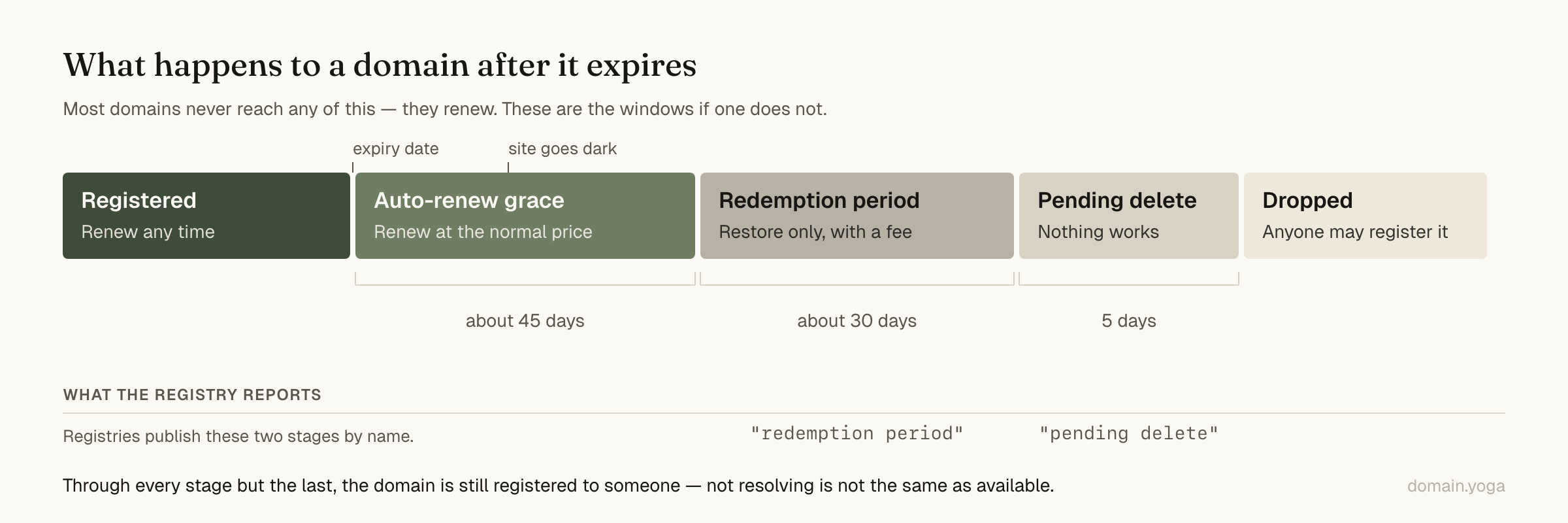
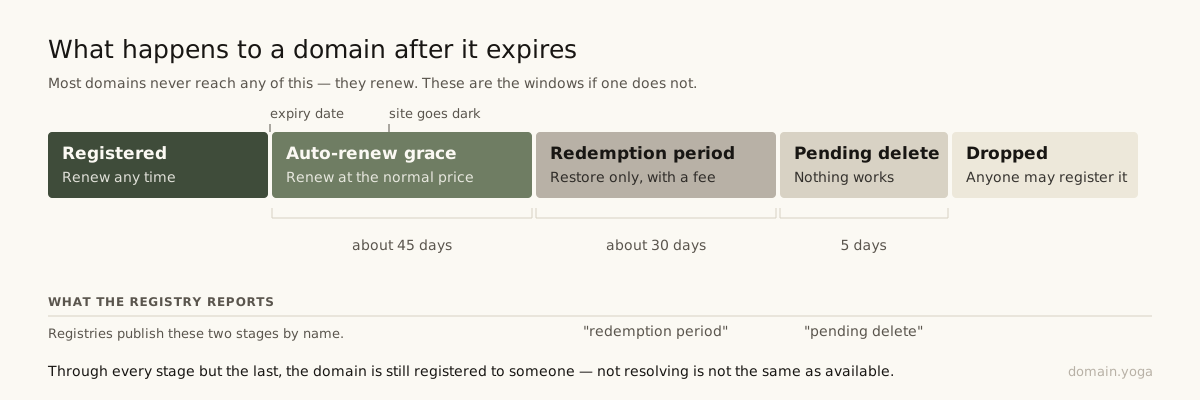
Stage 1: the renewal grace period — fix it at the normal price. Most registrars give you a window after expiry when a plain renewal at the regular price makes the whole thing go away. Don’t assume a number here: ICANN describes this Auto-Renew Grace Period as a “1–45 day” window that a registrar may offer, with the length and any fees disclosed in the registrar’s own terms. In practice that means up to ~45 days, but it genuinely varies — some registrars end normal-price renewal in under three weeks, others run close to the full 45 — so log in and check yours now. You weren’t supposed to reach this stage unwarned: ICANN requires registrars to send at least two reminders before expiry (roughly a month out, then a week out) and one more within five days after. At some registrars the site even keeps resolving for a few days — don’t bank on it.
And do not read “up to 45 days” as 45 leisurely days. Some registrars begin monetising the name well before that window closes. GoDaddy’s published expiration timeline, for instance, puts an expiring domain into a public auction from around day 26 — and once bids exist, simply renewing it can stop being an option at all. So the practical deadline may be your registrar’s auction start, not the end of the grace period. Check your registrar’s own timeline today rather than assuming the ICANN maximum is yours.
Stage 2: the domain goes dark — suspension. Somewhere inside that grace window, most registrars pull the domain out of service. The site stops loading, email starts bouncing, and a WHOIS lookup often shows a clientHold status. It feels like the end; it usually isn’t. You’re typically still one ordinary renewal away from being back online — the darkness is partly there to get your attention. We cover the status and its other causes in what clientHold means and how to fix it.
Stage 3: the Redemption Grace Period — 30 days, for you alone, at a price. Once your registrar actually deletes the registration, ICANN mandates a 30-calendar-day Redemption Grace Period for standard gTLDs. (The domain glossary defines RGP, pending delete, and the other terms in this article.) Three things are true during redemption: only you, the original registrant, can restore the name, and only through your registrar; DNS stays disabled the entire time, so there’s no limping along while you decide; and restoring costs a redemption fee on top of the normal renewal. Expensive, but safe — nobody else can touch the name for these 30 days.
Stage 4: pending delete — about five days, untouchable. If redemption lapses with no restore, the name moves into roughly five days of pending delete. Nobody can register, renew, or restore it now — not you, not your registrar, not even the drop-catch services circling overhead. Nothing to do here except prepare for the next stage.
Stage 5: the drop. The name is released back to the public pool, first come, first served. Your claim as the former owner is worth exactly nothing from here on.
What will it cost to get it back?
The price rises with each rung — the whole argument for moving today.
In the grace window: the ordinary renewal price. Usually the same money you’d have paid a month earlier (a few registrars add a modest late fee) — which is why the right response to noticing an expired domain is renewing within the hour, not researching options for a week.
In redemption: a restore fee on top of the renewal. There is no universal figure — the registry charges your registrar, and your registrar passes it through or marks it up — but fees commonly land in the ~$80–$200+ range, varying by registrar and TLD, and the registrar figures gathered for this article sit inside that spread. Check your own registrar’s current pricing page rather than trusting any number in an article, including this one. Even at-cost registrars charge one: Cloudflare’s FAQ confirms a restore fee that “varies depending on the TLD” without publishing an amount. For gTLDs, redemption is never free. Restore fees are one of the quieter ways registrars differ — see our registrar guide for indie hackers.
After the drop: whatever the market says. If nobody else wants the name, the standard registration price. If somebody does, you’re heading into backorders and auctions with no ceiling.
What if it’s already gone — deleted or dropped?
If the name is in pending delete, the strange comfort is that nobody can beat you to it yet. Use the ~5 days to get ready.
Once it drops, it’s a race — and for any name with visible value, the race is over in seconds. Automated drop-catching services take backorders in advance and fire registration attempts the instant a name is released; DropCatch, NameJet, SnapNames, and Pool.com are the established players. If several people backordered the same name, most services settle it with a private auction among those bidders — a backorder buys you a seat at the table, not the name. The playbook: place backorders with more than one service before the drop, set your maximum price in advance, and read how to buy a domain someone else holds, because from here on you’re an aftermarket buyer like everyone else. The silver lining is real, too: if your name is obscure, there’s a decent chance nobody is watching, and you simply re-register it at the normal price the day it becomes available. Obscurity is doing the work in that sentence: when we checked every Y Combinator domain, not one of the 3,714 .com names was free, including the 705 belonging to companies that had folded.
Does this apply to .uk, .eu, .de, or .io?
Mostly, no. Country-code TLDs run their own lifecycles, and nothing in the gTLD model above is guaranteed to apply — worth knowing before you build a brand on a country-code domain. A few verified examples:
.uk (Nominet): one continuous ~90-day renewal window instead of a grace-plus-redemption split. The domain is suspended around day 30 after expiry; you can renew through roughly day 90, and the name drops around day 95 — so the window to renew closes a few days before the name is actually gone.
.eu (EURid): a deleted name sits in a single ~40-day quarantine, during which it can be reactivated through a registrar. After that it’s re-released, first come, first served.
.de (DENIC): no pre-deletion grace period at all — but a fee-free 30-day redemption window restricted to the former holder (or someone the former holder names).
.io: despite the ccTLD label, .io now follows the standard gTLD-style lifecycle — a 30-day redemption period, then a 5-day pending delete. Ignore older guides describing a 90-day .io grace window; that doesn’t match the registry’s current documentation.
For any other ccTLD, go straight to that registry’s own policy page. Day counts, fees, and who may recover the name don’t transfer between ccTLDs.
How do you make sure this never happens again?
Three boring habits cover almost every expiry story.
Turn on auto-renew — and keep the card behind it alive. Auto-renew fails silently when the payment method on file has expired — a common cause of “surprise” expirations on accounts that did everything else right. Check your saved card whenever it’s reissued.
Keep the registrant email monitored. Those ICANN-mandated reminders are the entire early-warning system, and they’re worthless in an inbox nobody reads. A stale contact address means the registrar was technically compliant and you were never warned. Both habits belong in your first hour after registering a domain.
Consolidate if you hold many names. Expiry risk scales with scatter: five registrars, three cards, and no calendar is how a portfolio loses a domain. One registrar, one payment method, and a yearly review — the approach from domain strategy for serial builders — turns renewals into a single non-event.
And if the name truly got away — caught at the drop by someone faster — sometimes the cheapest recovery is a better name. Domain Yoga generates around 250 availability-checked, brandability-ranked ideas in seconds, so the next one can be a domain you never have to win back.
The grace periods are policy rather than goodwill. ICANN’s Expired Registration Recovery Policy sets out what a registrar must offer you and for how long, which is the document to quote if support tells you a name is gone.