Domain strategy for serial builders
By Domain Yoga · Last updated July 19, 2026
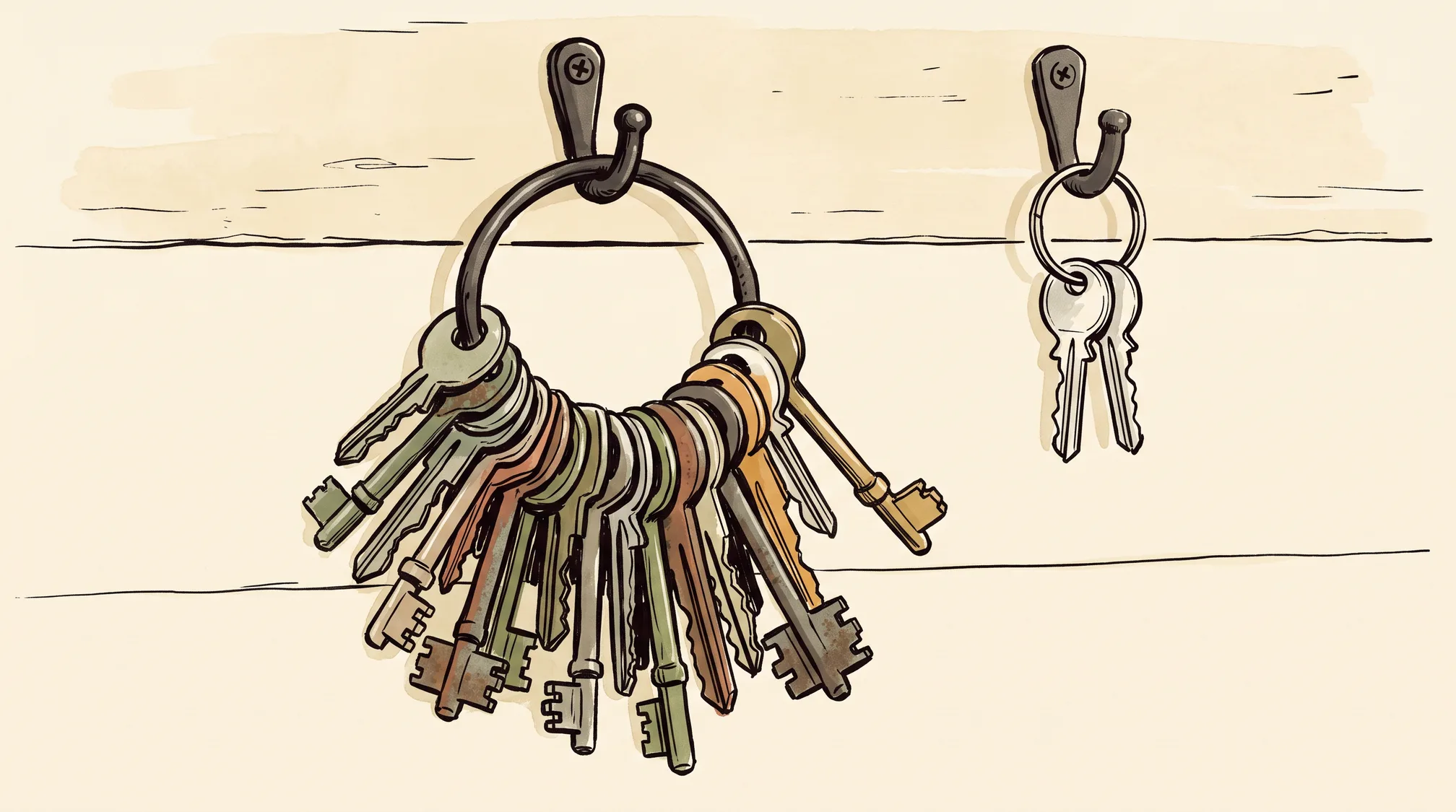
Somewhere in your registrar account is a domain for a project you abandoned two years ago. It renewed last month, it will renew again next year, and it has company — the newsletter that lasted four issues, the SaaS that never left localhost, the clever name you grabbed at 1 a.m. purely because it was available. This is the serial builder’s occupational hazard: registering a domain is optimistic and instant, while letting one go is a decision, so the pile only grows. Fifteen half-built projects quietly become twenty-something renewing domains that nobody is tracking. The fix is not to stop registering — you were never going to stop registering. It’s to accept that a domain portfolio needs hygiene: deliberate keep-or-kill decisions, made on a schedule, instead of accumulation by default.
Why can’t you just ignore the pile?
Because an unmanaged portfolio fails in both directions at once. The dead domains bleed money — each one is a small annual charge that’s individually ignorable and collectively a real bill for ideas that no longer exist. Meanwhile the live domains are exposed to the opposite failure: the one domain that actually matters lapses because its renewal notice went to an old email address, at a registrar you forgot you had an account with, on a card that expired. Paying for what you don’t need and losing what you do need are the same disease. Both come from not looking.
What does basic portfolio hygiene look like?
Three moves, none of them glamorous:
- Keep an inventory. One list: every domain, what it’s for, where it’s registered, when it renews, and what the renewal costs. A spreadsheet is fine; a note is fine. You can’t manage what you can’t see, and most builders discover at least one domain they’d forgotten they owned the first time they write this down. Update it when you register or drop something, and skim it once or twice a year.
- Auto-renew the live ones; deliberately lapse the dead ones. Sort every row into “park it” or “kill it.” Anything carrying a real project, real email, or real inbound links gets auto-renew switched on and a current payment method behind it. Everything else gets one honest question: will this ever ship? A domain you’re not using and won’t use is a subscription to a maybe, and sunk cost is the enemy here — the years you’ve already paid for are not a reason to pay for another one. If the project is dead, or it survived but lives under a different name now, turn auto-renew off on purpose and let the expiry date do the rest.
- Consolidate to one registrar — two at most. Domains scattered across five registrars mean five renewal-notice senders, five billing relationships, five DNS panels, and five chances for a stale card. Most “surprise” expiries aren’t surprises; they’re notices that went somewhere nobody reads. Transfers are mildly tedious and cost roughly a year’s renewal, but you do them once, and afterwards your entire portfolio is visible on one screen.
How do you stop the graveyard from regrowing?
The cleanup fixes the stock; a few habits fix the flow.
- Budget renewals as a real line item. Sum the renewal column of your inventory — that number is an annual subscription you’re paying, and it deserves the same scrutiny as any other one. While you’re at it, watch the renewal-price trap: the discounted first year is marketing, and the renewal is the actual price. A domain that’s cheap to acquire and expensive to keep is exactly the kind of row that clutters a builder’s portfolio.
- Don’t hoard speculatively. You are a builder, not a domain investor, and the economics are different: an investor holds names to sell them; you’d be holding names to feel prepared. A name you’re “saving for later” usually isn’t worth a decade of renewals, because good names are less scarce than they feel at 1 a.m. — if the idea ever becomes real, it will justify a fresh registration, and checking candidates in bulk takes minutes. The honest version of “saving it for later” is writing the idea down for free.
- Standardize the setup. Give every new domain the same treatment on day one — same DNS host, registrar lock and two-factor on, WHOIS privacy, and no-mail records if it won’t send email — the same first-hour checklist every time. A portfolio of identically configured domains is boring, and boring is the point: nothing is a special snowflake, nothing breaks strangely when you consolidate, and every project starts from a known-good baseline instead of whatever you improvised last time.
What actually happens if you let one lapse?
Less drama than you’d fear, less mercy than you’d hope. An expired domain doesn’t vanish at midnight: typically there’s a registrar grace period during which you can still renew at the normal price, then a roughly 30-day redemption period where recovery is possible but costs a registrar-set fee well above a normal renewal, then around five days of pending delete where nobody — including you — can save it, and then it drops back into the public pool, where desirable names are often caught by drop-catching services within seconds. The exact timings vary by registrar and TLD, so treat all of this as approximate. The practical read: a lapse you catch within days is usually fixable, which is comforting, but redemption pricing means “I’ll just grab it back if I change my mind” is not a strategy. Decide before the expiry date, not after.
A tidy portfolio isn’t a big system — it’s a short list, auto-renew in the right places, and one honest hour a year deciding what dies. And when the next real idea arrives, add its domain deliberately: Domain Yoga generates names and checks availability in one pass, so the next row in your inventory is one you actually mean to keep.
When a name is finished with, selling, parking or dropping domains covers the three exits and what each is realistically worth.