Subdomain or new domain? Where your next project should live
By Domain Yoga · Last updated July 20, 2026
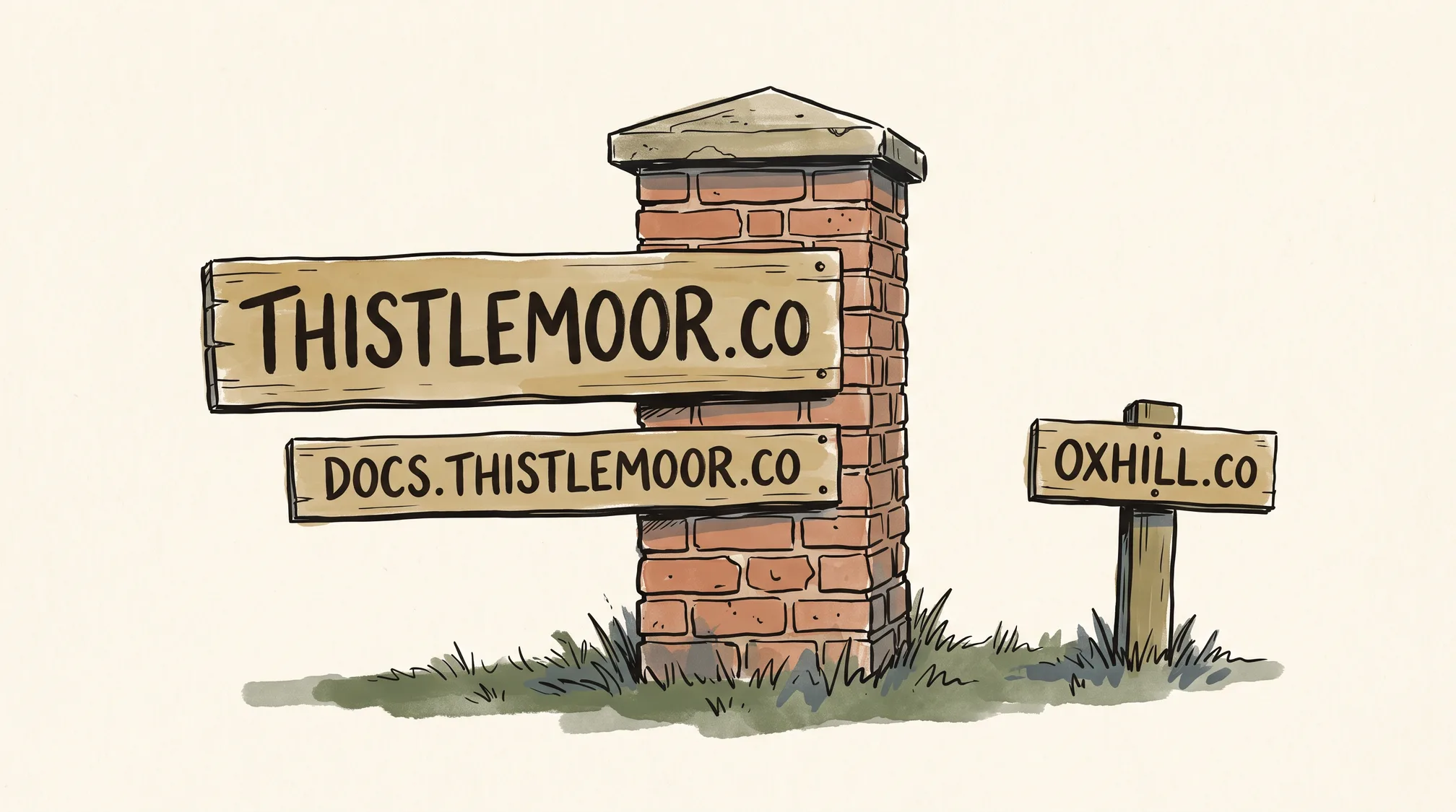
The rule fits in one line: if the new thing shares your brand and your audience, put it on a subdomain — app.acme.com, docs.acme.com, blog.acme.com — and if it’s a separable business or a genuinely distinct identity, register a new domain. Everything below is that sentence with its edge cases. A subdomain lives under a domain you already own: no new registration, nothing to pay, live the moment you point DNS at it. A new domain is a fresh brand surface — a new thing to name, buy, secure, and keep alive in people’s heads. The stakes are lower than they feel, because both choices are reversible, but picking right the first time saves you a migration later.
What’s the actual difference between the two?
A subdomain is a prefix on a domain you already control; a new domain is a separate registration. In the anatomy of a domain name, acme.com is the registrable part — what you pay a registrar for once a year. blog.acme.com, app.acme.com, and status.acme.com are subdomains of it: you create them yourself in your DNS panel, as many as you want, for free, in seconds. Nothing new is registered, nobody bills you, and each one inherits whatever recognition and trust acme.com has already earned.
A new domain starts from zero on every axis: a yearly registration fee, its own DNS, its own TLS certificate, its own reputation to build, and — the expensive part — its own name that customers must learn alongside your first one. Worth paying when the thing deserves a separate identity; pure waste when it doesn’t.
When should you use a subdomain?
When the new thing is the same brand speaking to the same audience. If someone who knows acme.com would nod and think “of course” on landing at the new address, it belongs on a subdomain. The usual residents:
- Your app.
app.acme.comis the conventional home for the logged-in product behind your marketing site. - Docs and help.
docs.acme.comandhelp.acme.comare exactly where technical readers and support-seekers expect them. - A blog or changelog. Content that builds your brand’s authority, published under your brand’s name.
- A status page.
status.acme.comis nearly a convention — people guess it. - Staging and dev environments.
staging.acme.comkeeps your not-yet-public work namespaced under a domain you already own.
Every one of these inherits your existing recognition, costs nothing extra, and ships immediately. There’s no naming decision, no checkout, and no second brand to maintain. When the answer is “same brand, same audience,” the subdomain isn’t a compromise — it’s just correct.
When should you register a new domain instead?
When the thing could stand on its own. A new root domain earns its cost precisely when sharing the parent brand would be limiting, confusing, or wrong:
- It’s a genuinely separate product or brand. Not a feature of the existing thing — a different thing, with its own audience and its own story to tell.
- You might spin it out, sell it, or run it independently. A project that could one day have its own company, team, or buyer needs its own domain from the start. Untangling a spun-out product from a subdomain later is real work.
- It’s a campaign or microsite that needs its own identity. A launch, a standalone tool, a conference — something deliberately not wearing the house colours.
- Sharing the parent brand would dilute or confuse. If bolting the new thing onto your existing name muddies what either one stands for, give it its own name.
Weighing several of these at once is portfolio thinking, with its own discipline — which defensive registrations are worth it and which are checkout upsells (should you register multiple domains?), and how to keep a growing collection from becoming dead weight (domain strategy for serial builders).
Doesn’t a subdomain hurt your SEO?
This is a real consideration for content you want to rank — not a settled law. The old debate is subdomain versus subfolder: is blog.acme.com weaker than acme.com/blog? Google can crawl and rank content in both, and has repeatedly said it treats subdomains and subfolders largely the same. No penalty either way.
The nuance many SEOs still act on: keeping rankable content in a subfolder concentrates one domain’s authority in a single place, rather than spreading it across addresses the search engine may treat as somewhat separate. Reasonable people disagree about how much this matters, which is exactly why it’s a consideration and not a rule. Keep it in proportion: it matters mainly for content you’re actively trying to rank — a blog, a resource library — and barely at all for an app or a status page nobody is optimising for search. And your domain string was never the real lever anyway; what ranks is content quality, not keywords in the address. If SEO is the whole game for a piece of content, a subfolder is the safe default. Otherwise, pick for clarity and ship.
What about developer subdomains?
One extension quirk is worth knowing. Developer-facing subdomains like api.acme.com are subdomain territory by default. But if the new project wants its own developer-flavoured root domain, the .dev and .app extensions enforce HTTPS at the browser level: you need a working TLS certificate before the site loads at all. It’s a non-issue on modern hosting and a real gotcha on hand-rolled servers — worth reading up on before you register: see .dev and .app domains for developers.
What’s the rule when you’re genuinely unsure?
Same brand, same audience → subdomain. Separable business or distinct identity → new domain. That decides the clear cases, which is most of them. For the ambiguous ones, the tiebreaker is optionality: when the new thing is a product that might grow into its own business, a fresh brandable domain keeps your options open, and the small cost buys the freedom to spin it out later without a rebrand. A subdomain is cheaper today; a new domain is cheaper the day you outgrow the shared name.
If that tiebreaker points you toward a new domain, Domain Yoga turns a plain description of what you’re building into brandable, availability-checked names in seconds — so the naming part doesn’t become the reason you defaulted to a subdomain.
This decision comes up most often for products, which is why the product name generator opens with it.
If the subdomain in question is one a platform handed you rather than one you control, the decision is a different one: custom domain or platform subdomain.