Which TLD should you actually use? A decision guide
By Domain Yoga · Last updated July 28, 2026
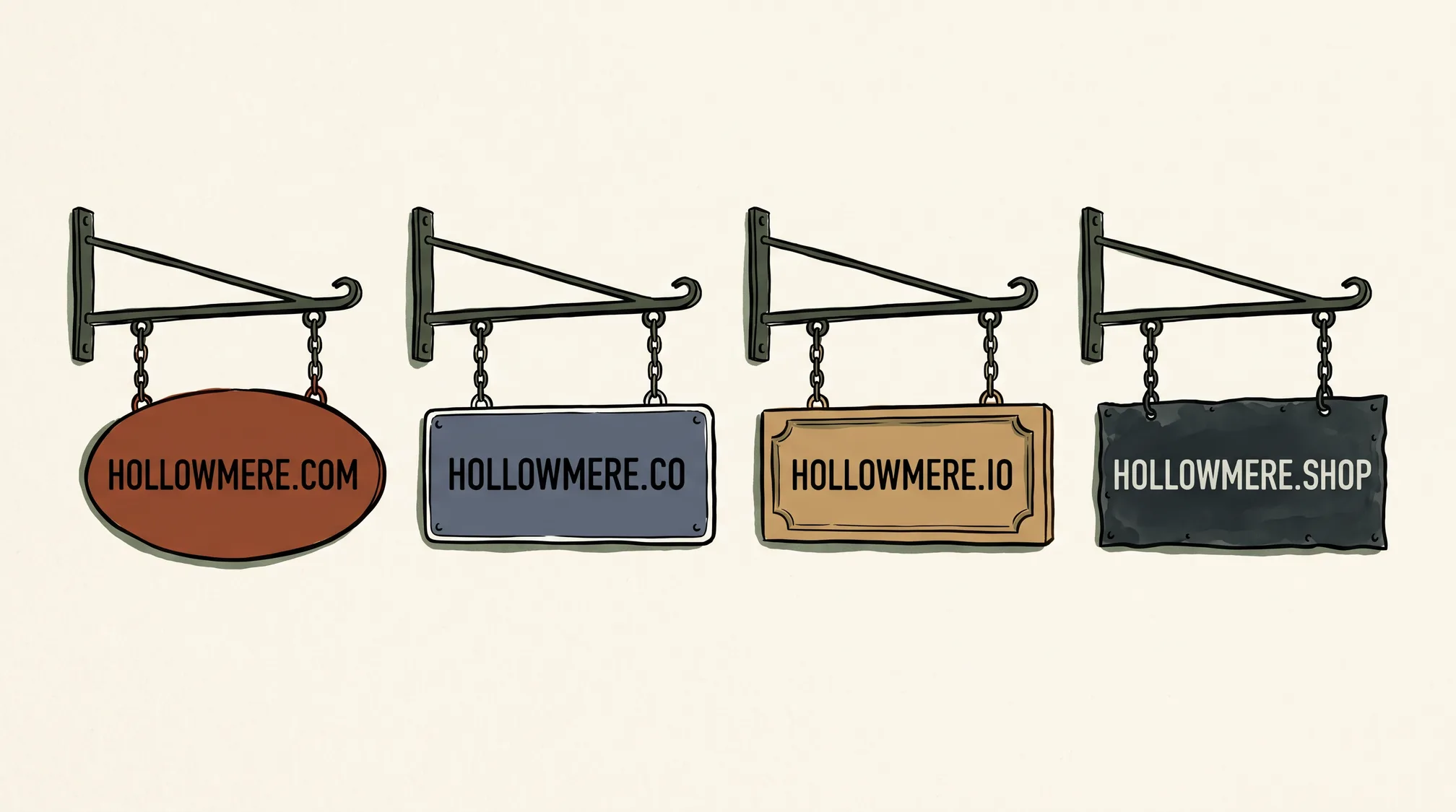
For most people, the answer is .com — if a name you like is available on it at a price you can absorb, take it and stop deliberating. The one question that most changes that answer is who your audience is: developers parse .io and .dev without blinking, an AI product can say more with .ai than with a tagline, and a German consumer trusts .de on sight. Everything else — budget, geography, whether the extension is part of the name — is a tiebreaker. This guide walks those questions in order, gives you a recommendation at each branch, and points to the deeper article on whichever answer you land on.
Shouldn’t SEO settle this?
No, because Google already settled it in the least helpful way possible: the TLD is not a ranking signal. A .com, .io, .ai, and .pizza with identical content rank identically, keywords in the extension do nothing, and newer extensions carry no penalty — the company’s position has held steady for over a decade, and do exotic TLDs hurt SEO? has the receipts. So take rankings off the table. Every question below is about humans.
Do you actually need the .com?
The .com’s entire advantage is the human default — the extension people assume, type from memory, and never need explained. So ask how people will reach you:
- Your audience is mainstream and non-technical, your name will be heard aloud or live in print, or a competitor sits on yourbrand.com. You’re in .com territory. Habit-typers will go there whatever your business card says, and every spoken mention of an alternative extension needs a footnote. When you genuinely need the .com walks the honest cases — buy it, or pick a name whose .com is still free.
- Your product is reached by search, shared links, and app stores. The .com premium buys a door nobody walks through. An aftermarket .com routinely runs four or five figures while a solid alternative costs about $12 — pre-product, that difference is runway. Keep reading; the next questions pick your alternative.
- You want the name, but the .com is taken. That’s not a veto on the name. The domain you want is taken covers your moves; the questions below cover your extension.
Is your audience technical?
If yes, you’ve reached the four-way junction our .com vs .io vs .ai vs .co comparison covers in depth — here are the one-line verdicts, then hand off:
- Developer tools, APIs, infrastructure → .io. The default in dev-tool circles — with one sovereignty asterisk, covered there.
- AI is the product, not a garnish → .ai. The category signal justifies the price only if AI is genuinely the pitch. And it is a price: roughly $80–160 per year, and you must buy two years at once — call it $160–320 at checkout, which is a .ai domain worth it? works through properly.
- Great name, taken .com, broad audience → .co. The credible fallback, and it reads naturally to non-technical people too — with one typo-leak caveat the comparison covers.
- You want HTTPS enforced from day one → .dev or .app. Both Google-run extensions are baked into browsers’ HSTS preload list, so no .dev or .app site can load over plain HTTP — a genuine feature for developer tools and documentation, with exactly one gotcha (you need a TLS certificate before the site loads at all) covered in .dev and .app domains for developers.
If your audience isn’t technical and the .com case above didn’t fire, .co is your default from this group. And whatever you landed on here, keep going — geography, the name itself, and budget can each override it.
Are you a nonprofit, a community, or a public-interest project?
Then .org is your default — and the worry that stops most people is simply unfounded. .org has never required nonprofit status, verifies nothing, and is open to anyone, which surprises almost everyone who assumes otherwise. It’s the third-largest generic extension, past 12 million registrations, and for an association, a charity, a community project or a foundation it’s what readers expect to see. Two caveats decide the edge cases. If you’re a for-profit, .org lends you a credibility association you haven’t earned, and the evidence that it actually moves trust is thin in both directions. And if you want the domain itself to prove you’re a genuine NGO — a real concern for organisations that face scepticism — .org cannot do that, precisely because it checks nobody; PIR’s .ngo and .ong require documentation and ongoing audits instead. Is a .org domain worth it? works through both cases, including what actually happened to .org pricing after its price cap was removed.
Are you serving one country — or Europe as a bloc?
Geography is the one place a TLD does something mechanical: a normal country-code extension like .de or .fr automatically tells Google your site targets that country. That’s a feature for a local business and a constraint for a global one — though .io, .co, .ai, .me, and .tv sit on Google’s “generic” list as of 2026 and geotarget nowhere.
- One European market → that country’s ccTLD. For a founder selling into Germany, .de does trust work on sight that no generic extension can, and the eligibility folklore is often years out of date — .de has been open worldwide since 2018, and .fr needs ordinary EU-area residence, not a French company. European country-code domains for founders has the registry-by-registry rules.
- Pan-European by design → .eu. Only people and organisations with an EU/EEA connection — citizenship, residence, or an established entity — can hold one, a light credibility signal for European customers. Those rules are also a real dependency: Brexit-era UK registrants had domains suspended and eventually revoked when they stopped qualifying. Is a .eu domain worth it? weighs both sides.
- Global product → stay generic: .com if the .com case fired, otherwise .co, or .io / .ai / .dev per the previous section.
Is the extension part of the name itself?
Sometimes the dot does brand work — a name that spells across it, or an industry extension that says what you are. Two branches:
- Domain hack → check the registry before you fall in love. Every two-letter code belongs to a real territory with its own rules: .sh, .to, .gg, and .so are open workhorses, while .ly reserves names shorter than four characters for registrants with a Libyan presence, and has actually seized live domains over content. Country-code domain hacks catalogs each one’s quirks.
- Accented or non-ASCII name → check IDN support per TLD. Most European registries happily register müller.de, but .nl allows no accents at all and .com bans ß outright — and email support is where the real friction lives. Accents, umlauts & IDNs maps it.
Does budget decide it?
It can, safely — cheap and credible are entirely compatible, as long as you dodge two traps. First, judge every extension by its renewal price, never the first-year promo: one registrar has sold a .com for a cent that renews at $19.99 a year, and the gap depends on the registrar as much as the TLD — the renewal trap has same-day numbers. Second, avoid rock-bottom extensions with heavy spam registration, because spam filters track reputation by TLD and your email deliverability can genuinely suffer. The extensions that read as legitimate in tech circles — .co, .me, .io, .app, .dev — cost far less than a premium .com and carry little to no stigma; the cheapest TLDs that don’t look cheap draws the line, and is honest that this is perception rather than measurement. And if you’re browsing wider, there are roughly 1,200 newer extensions to choose from — the complete guide to new gTLDs maps that landscape.
Where does each road lead?
The whole guide in one pass:
| Your situation | Use | Read more |
|---|---|---|
| Mainstream audience; name spoken or printed | .com | When you genuinely need the .com |
| Broad audience, .com taken | .co | .com vs .io vs .ai vs .co |
| Developer tool, API, infrastructure | .io | .com vs .io vs .ai vs .co |
| Developer-facing, want enforced HTTPS | .dev / .app | .dev and .app for developers |
| AI is the product | .ai | Is a .ai domain worth it? |
| Nonprofit, association, or community project | .org | Is a .org domain worth it? |
| One European market | That country’s ccTLD | European ccTLDs for founders |
| Pan-European by design | .eu | Is a .eu domain worth it? |
| The dot is part of the name | The hack’s ccTLD | Country-code domain hacks |
| Tight budget | .co, .me, .io, .app, .dev — at renewal price | Cheapest TLDs that don’t look cheap |
One closing reframe: the extension is the smaller half of the decision — a strong, distinctive name carries more weight than any suffix, and finding one is the real work. If you want to run both halves at once, Domain Yoga turns a plain-language description of your product into around 250 availability-checked name ideas per search, ranked on brandability signals (see our methodology) and spread across many extensions — the same name compared side by side before you commit. A search costs $2–$5, there’s no subscription, and credits never expire.